Astronomia Brasil
notíciasNASA

Erupções de uma estrela massiva

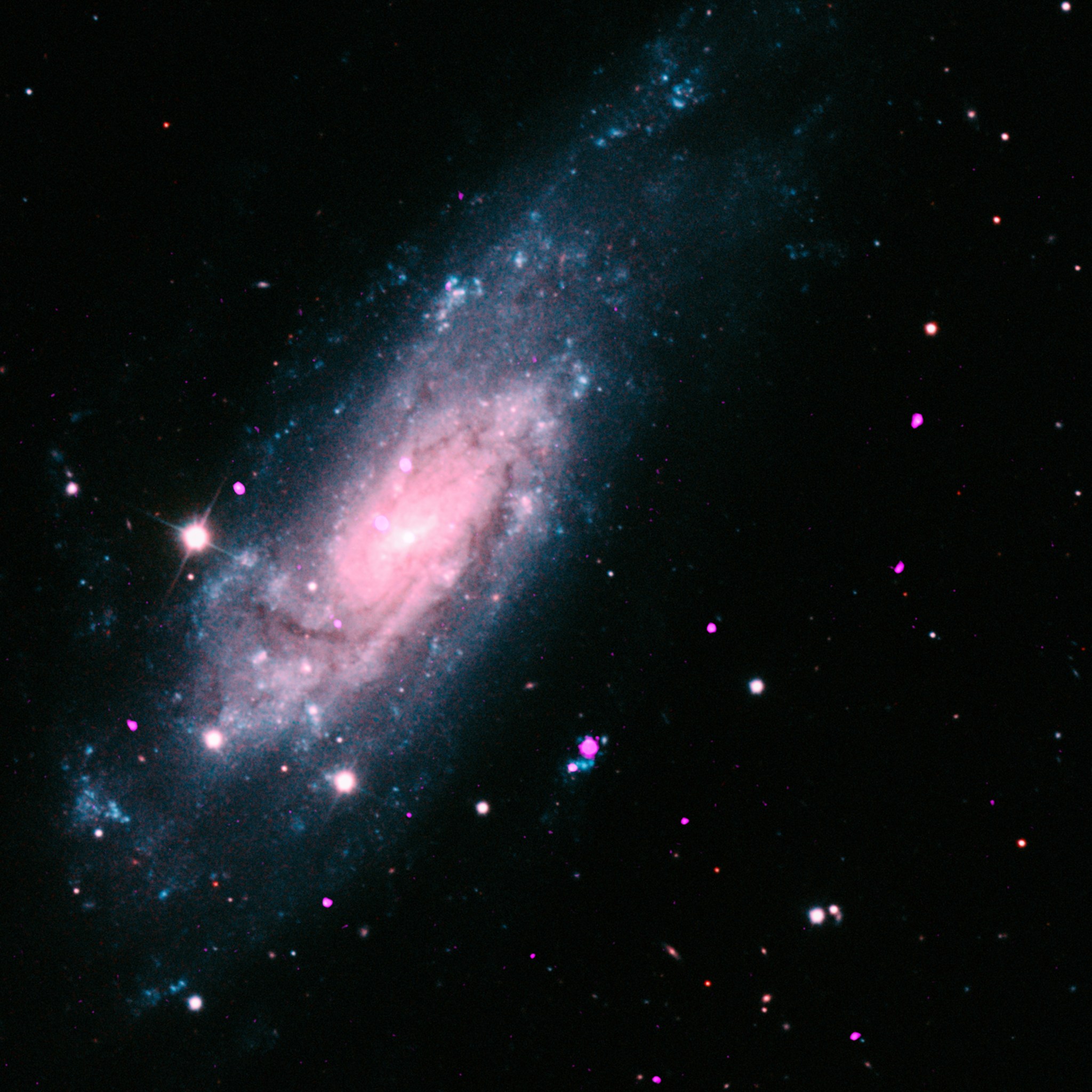
Using Chandra, astronomers have discovered the star’s previously hidden companion, which triggers luminous outbursts every 113 days. The spiral galaxy is NGC 4559. Shown at a sharp angle in the composite image, its flat pink and milky blue face tilts toward our upper left. Sitting near the outer edge of the dense spiral, near the center of the frame, is a small group of pink and blue dots. This group is outlined with a white square, enlarged and annotated in supporting images. The smallest pink dot in the square is AT 2016blu, a massive star some 33 times the size of our Sun. For over 15 years astronomers have been watching this star get bright and then dim again in optical light on a regular basis. Chandra’s X-ray observations suggest that a hidden companion object, either a stellar mass black hole or a neutron star, is pulling material from AT 2016blu every 113 days as they orbit one another. This captured material gets so hot that it shines brightly in X-rays. Other pink and blue specks within the white square and enlargement are unresolved stars or star clusters, too distant to be related to the movement of material between AT 2016blu and its hidden but influential neighbor.
Raios X: NASA/CXC/Univ. of Virginia/M. Aghakhanloo et al.; Óptico: SDSS; Processamento da imagem: NASA/CXC/SAO/P. Edmonds

Usando o Observatório de raios X Chandra, da NASA, astrônomos descobriram o que está provocando as erupções repetidas de uma estrela gigante e instável localizada na galáxia mostrada nesta imagem, divulgada em 9 de novembro de 2026.

A estrela volátil, conhecida como AT 2016blu, fica na galáxia espiral NGC 4559, a cerca de 30 milhões de anos-luz da Terra. Os astrônomos estimam que a massa dessa estrela seja pelo menos 33 vezes maior que a do Sol.

Leia mais sobre a descoberta.

Crédito da imagem: Raios X: NASA/CXC/Univ. of Virginia/M. Aghakhanloo et al.; Óptico: SDSS; Processamento da imagem: NASA/CXC/SAO/P. Edmonds