
Astronomia Brasil
notíciasNASA

Fusão antiga da Via Láctea

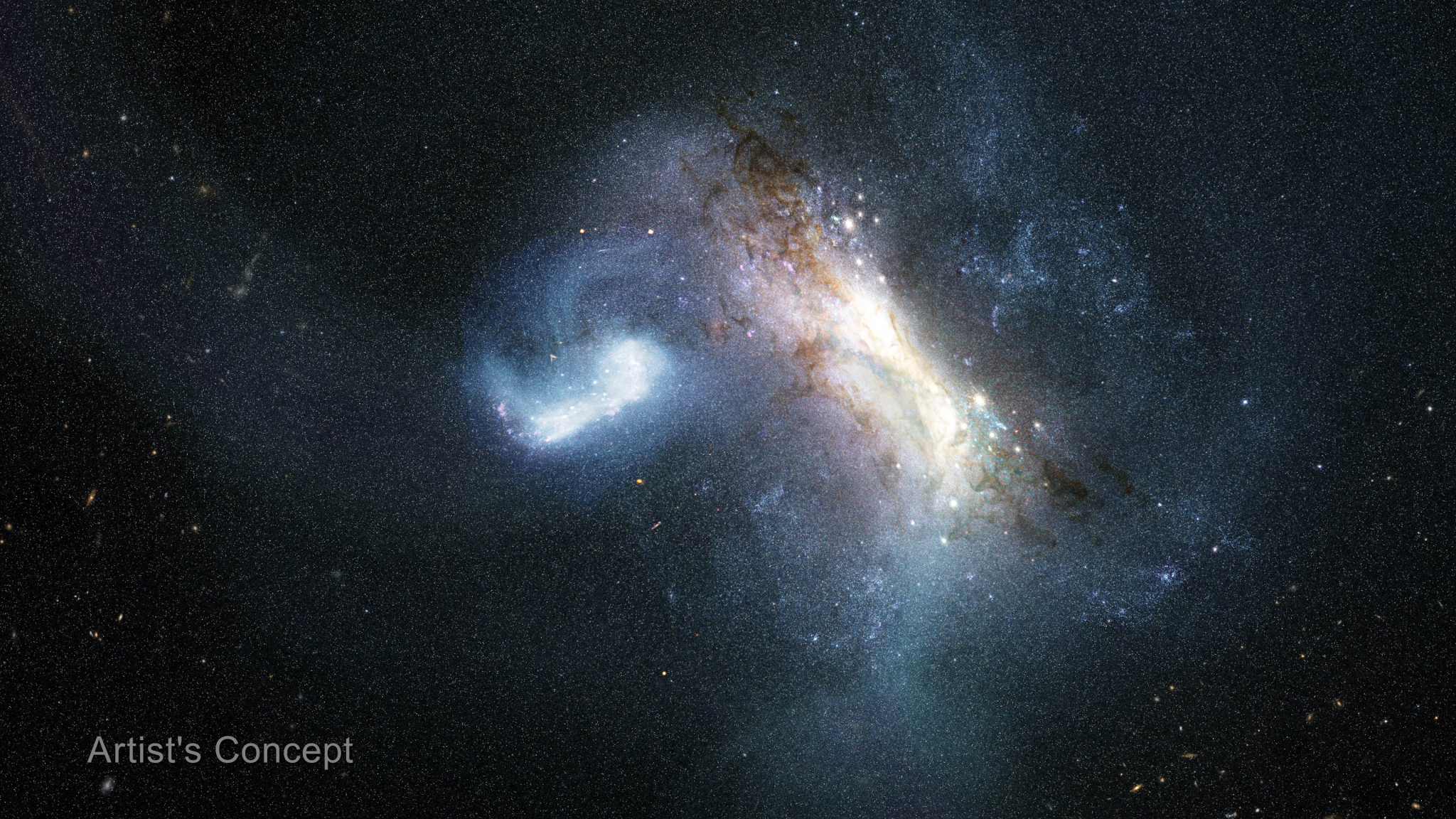
An illustration of two galaxies in the midst of a collision against a dark, star-filled background. The collision takes up the middle third of the illustration. On the right, a larger galaxy is viewed at an angle from 11 o’clock to 4 o’clock, with a white-yellow core surrounded by mottled brown dust lanes and faint bluish spiral arms. To the left, a smaller, bright blue-white galaxy is stretched into a curved, hook-like shape as gravity distorts it. A broad, glowing bridge of pale blue gas and stars extends off the galaxy at the left, while wispy streams extend above and below the larger galaxy at the right. The words “Artist’s Concept” appear in the lower left corner.
Há cerca de 12 bilhões de anos, uma galáxia anã conhecida como LKH colidiu com a jovem Via Láctea e se fundiu a ela. Este conceito artístico retrata essa colisão. O Hubble Space Telescope da NASA encontrou evidências definitivas dessa colisão ao estudar aglomerados estelares globulares. NASA, ESA, Joseph Olmsted (STScI)

Este conceito artístico , divulgado em 17 de agosto de 2026, retrata uma colisão entre a nossa galáxia, a Via Láctea, e uma galáxia anã conhecida como LKH, ocorrida há cerca de 12 bilhões de anos. Um estudo de dados do Hubble Space Telescope da NASA, publicado recentemente na revista Nature Astronomy , mostra evidências definitivas de que uma galáxia anã se fundiu com a jovem Via Láctea nos estágios iniciais de sua evolução. Essa descoberta amplia nosso conhecimento sobre a história da nossa galáxia em 1,8 bilhão de anos em relação ao que se conhecia anteriormente.

Leia sobre esta descoberta.

Crédito da imagem: NASA, ESA, Joseph Olmsted (STScI)