Astronomia Brasil
notíciasNASA

O estudo do pulsar na Nebulosa da Lanterna feito pelo Chandra e pelo IXPE da NASA

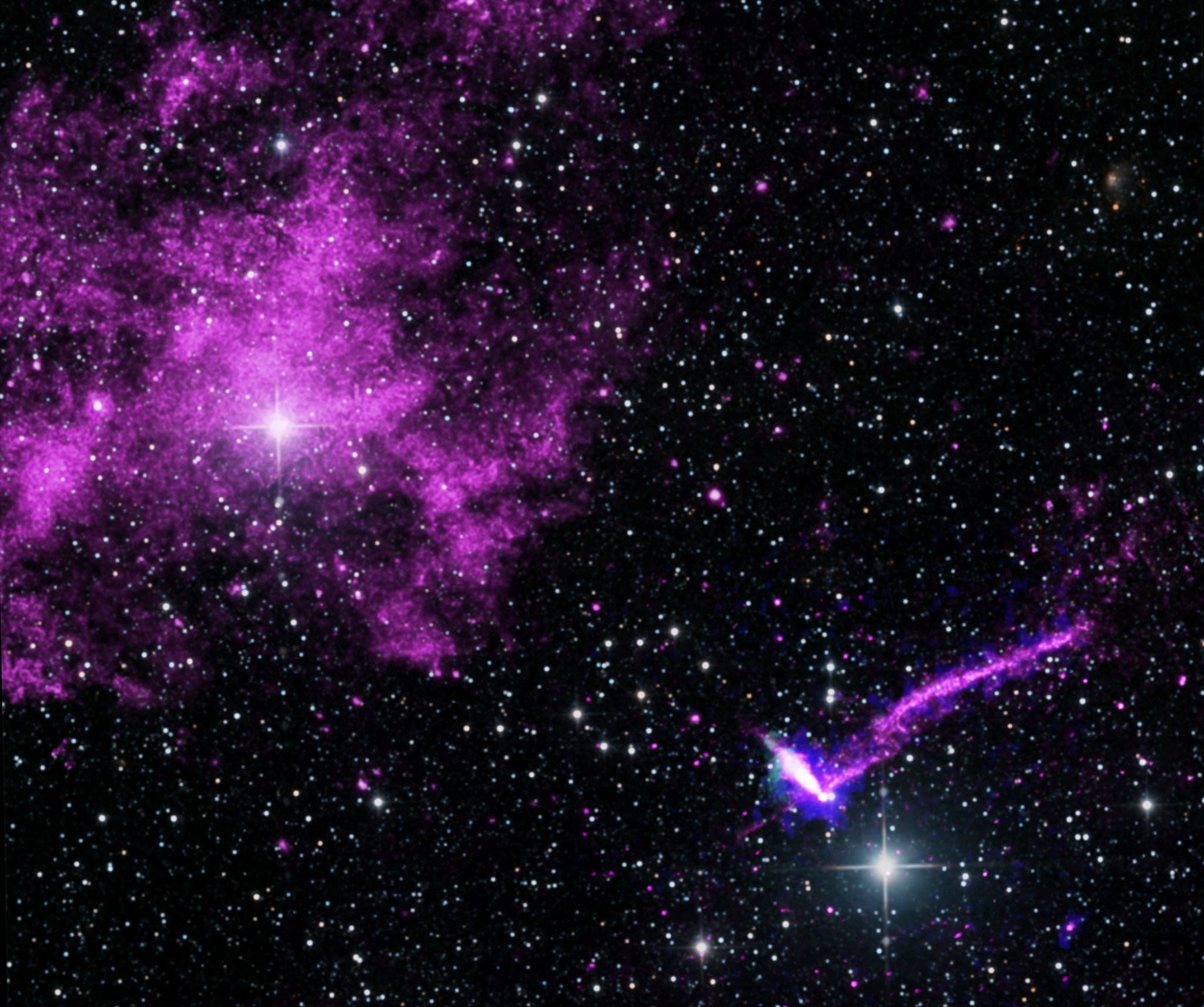
This composite multiwavelength image captures the turbulent environment surrounding the Lighthouse pulsar, set against a vast, black background speckled with twinkling white and faint green stars. In the upper-left quadrant, a massive, cloud-like nebula glows in a textured, vibrant purple hue, anchored by a prominent four-pointed star shining brightly near its center. Moving toward the lower-right quadrant, the pulsar itself is located at the lower tip of a concentrated, brilliant whitish-blue elongated point of light. Extending outward from its core is a long, narrow, and slightly curved jet of purple and blue emission that streaks upward and to the right. This jet represents a massive 37-light-year tail of high-energy particles trailing behind the rapidly spinning star as it plow through interstellar space. This composite image contains X-ray data from NASA's Chandra X-ray Observatory in purple, additional X-ray from NASA's IXPE in blue, and radio data from CSIRO in green. The starfield is optical data from the 2MASS survey.
Cientistas usando o IXPE (Imaging X-ray Polarimetry Explorer) da NASA mediram diretamente, pela primeira vez, os campos magnéticos de PSR J1101−6101, um pulsar localizado dentro daquilo que muitas vezes é chamado de Nebulosa do Farol. Raios X: Chandra: NASA/CXC/Stanford Univ./J. Dinsmore et al.; IXPE: NASA/MSFC/J. Dinsmore et al., Rádio: CSIRO/ATNF/ATCA; Óptico: 2MASS/UMass/IPAC-Caltech/NASA/NSF; Processamento da imagem: NASA/CXC/SAO/L. Frattare

Esta imagem composta, divulgada em 9 de julho de 2026, mostra a região ao redor de um pulsar — uma estrela de nêutrons com um campo magnético intenso que gira incrivelmente rápido — dentro da Nebulosa do Farol. A imagem reúne dados em raios X do observatório de raios X Chandra, da NASA, em roxo, raios X do IXPE (Imaging X-ray Polarimetry Explorer), da NASA, em azul, e emissão de rádio capturada pelo Australia Compact Telescope Array, em verde.

Pela primeira vez, cientistas usaram o IXPE para medir diretamente os campos magnéticos do pulsar. Os resultados trazem novas percepções sobre a estrutura de alguns dos objetos mais extremos do cosmos, enquanto a NASA continua a explorar os segredos de como o universo funciona. Um artigo descrevendo os resultados foi publicado em 9 de julho no Astrophysical Journal.

Saiba mais sobre esse uso inovador do IXPE.

Crédito da imagem: Raios X: Chandra: NASA/CXC/Stanford Univ./J. Dinsmore et al.; IXPE: NASA/MSFC/J. Dinsmore et al., Rádio: CSIRO/ATNF/ATCA; Óptico: 2MASS/UMass/IPAC-Caltech/NASA/NSF; Processamento da imagem: NASA/CXC/SAO/L. Frattare