Astronomia Brasil
notíciasNASA

O que está acontecendo: dicas de observação do céu de agosto de 2026 da NASA

Um eclipse solar, as Perseids, Vênus brilhando no céu após o pôr do sol e um profundo eclipse lunar parcial destacam o céu para observação de agosto.

Destaques da observação do céu

  • 5 de agosto: Lua em Quarto Minguante
  • 12 de agosto: eclipse solar total atravessando o norte da Rússia, a Groenlândia, a Islândia, o norte da Espanha e parte de Portugal; eclipse parcial em partes dos EUA; Lua Nova
  • 12-13 de agosto: pico da chuva de meteoros Perseid sob céus escuros
  • 14-16 de agosto: Vênus atinge a maior elongação oriental e brilha baixo no oeste após o pôr do sol
  • 27-28 de agosto: eclipse lunar parcial visível a partir de grande parte da América do Norte e da América do Sul e de partes da Europa e da África

Transcrição

Um eclipse solar, uma das melhores chuvas de meteoros do ano, Vênus no seu maior brilho no céu da noite, e um eclipse lunar para encerrar o mês.

Esse é o “What’s Up” de agosto.

No dia 12 de agosto, um eclipse solar total atravessa o norte da Rússia, a Groenlândia, a Islândia e o norte da Espanha, com um pequeno canto de Portugal dentro da faixa de totalidade.

Em partes dos Estados Unidos, de Alasca até a Carolina do Norte, o eclipse é parcial. A Lua vai “morder” apenas uma pequena parte do Sol, e a quantidade de cobertura varia conforme a localização.
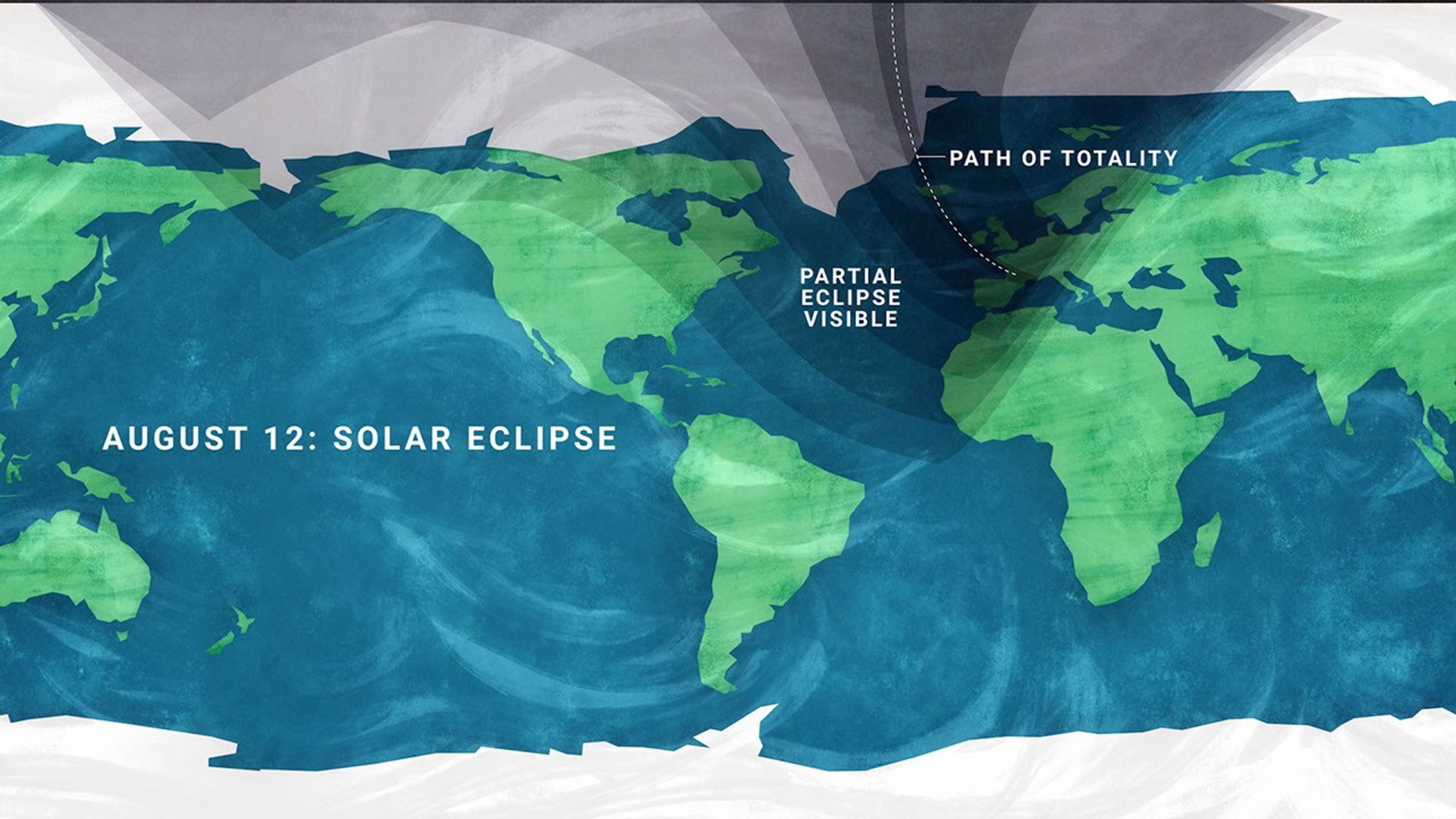
A stylized flat map of the Earth indicating the viewing areas for a solar eclipse, with text on the left reading 'AUGUST 12: SOLAR ECLIPSE'. A semi-transparent dark shadow covers the northern portion of the globe, fanning out from the top edge. Within this shadow, a thin dotted line arcs down from the Arctic, crossing near Greenland and Iceland, passing over the Iberian Peninsula (Spain and Portugal), and ending near the Mediterranean Sea; this line is labeled 'PATH OF TOTALITY'. The broader shaded region surrounding this line is labeled 'PARTIAL ECLIPSE VISIBLE', and it covers northern North America, the Arctic, all of Europe, northern Africa, and northern and western Asia. The unshaded regions covering the rest of the map, including most of the United States, South America, central and southern Africa, and Australia, indicate areas where the eclipse will not be visible.
Um mapa mostrando as áreas de visualização do eclipse solar total de agosto de 2026. — Crédito: NASA/JPL-Caltech

Lembre-se de observar com segurança. Use óculos de eclipse certificados ou um visualizador solar seguro sempre que qualquer parte do Sol estiver visível. Óculos de sol comuns não são seguros. E nunca use binóculos, um telescópio ou uma câmera sem um filtro solar feito para a parte frontal das lentes.

Mais tarde naquela mesma noite, a chuva de meteoros Perseid vai iluminar o céu, atingindo o pico na noite de 12 de agosto até as primeiras horas da manhã de 13. E, com a Lua Nova chegando em 12, o céu ficará idealmente escuro.

As Perseids acontecem todos os anos quando a Terra atravessa uma corrente de detritos deixada para trás pelo Comet Swift-Tuttle. À medida que esses pequenos fragmentos de poeira do cometa atingem nossa atmosfera em alta velocidade, eles se incendeiam, queimando como faixas luminosas brilhantes.

Para ver essa chuva de meteoros, olhe para o nordeste assim que estiver totalmente escuro e observe a constelação Perseus se elevar acima do horizonte. É dali que os meteoros se originam, mas deixe seus olhos passearem, porque eles podem surgir e brilhar em qualquer parte do céu.

Para a melhor visualização, fique acordado até mais tarde, quando as estrelas estiverem mais altas, encontre um local escuro e aberto e dê aos seus olhos 30 minutos para se ajustarem.
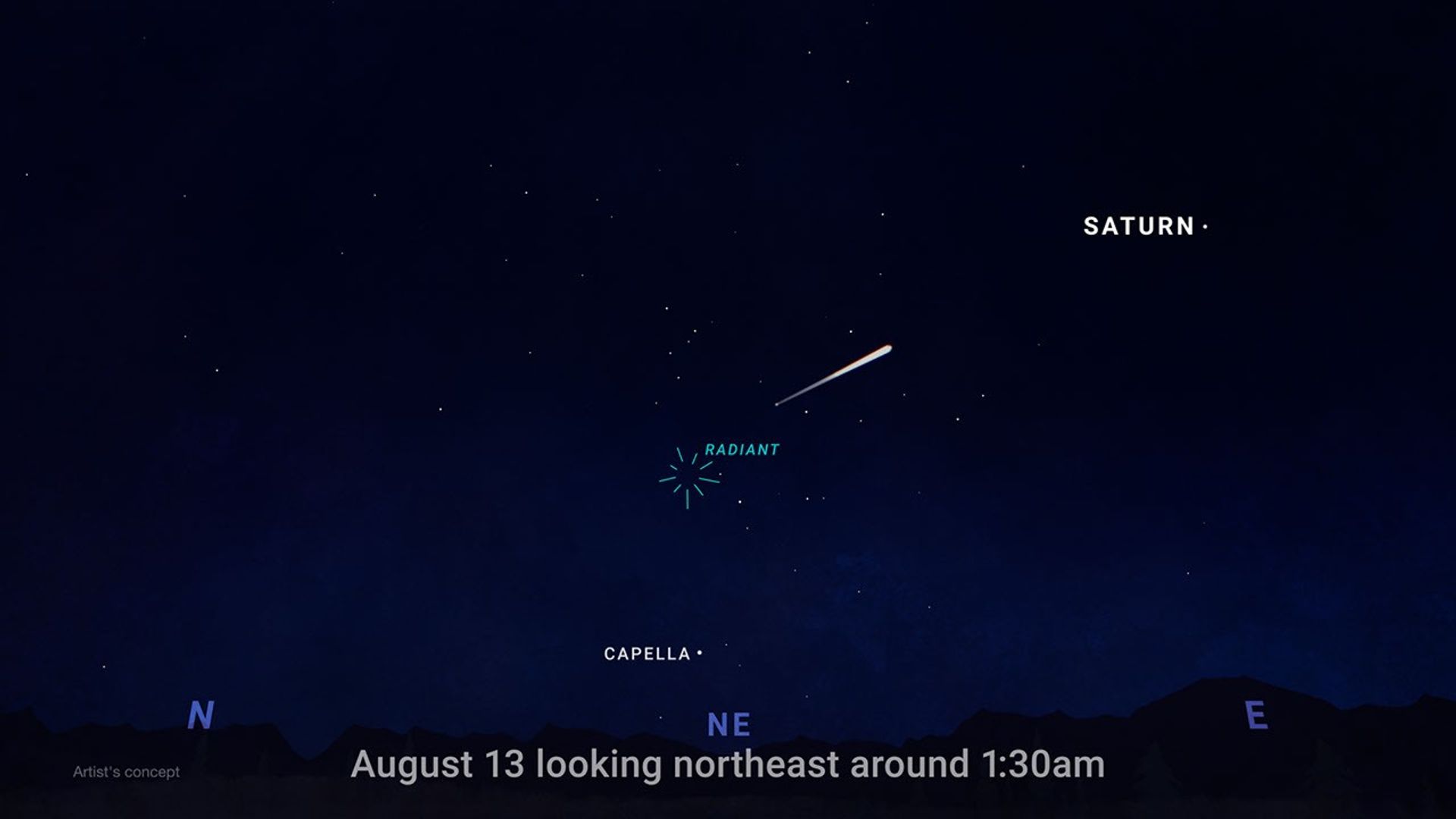
An illustration of the night sky showing where to look for meteors, with text at the bottom reading 'August 13 looking northeast around 1:30am.' The bottom of the image shows a dark, silhouetted horizon of hills, marked with blue compass directions N (North), NE (Northeast), and E (East). In the center of the sky above NE is a teal burst icon labeled 'RADIANT,' indicating the point from which meteors appear to originate. A bright, white meteor streaks across the dark, starry sky, pointing back toward the radiant. Two other bright celestial objects are labeled: the star 'CAPELLA' is situated low in the sky below the radiant, and the planet 'SATURN' is positioned high up in the upper right corner. Small text in the bottom left corner reads 'Artist's concept.'
Esta ilustração mostra onde no céu noturno observar a chuva de meteoros Perseid. — Crédito: NASA/JPL-Caltech

De 14 a 16 de agosto, Vênus atinge sua maior elongação oriental, que é a maior separação aparente do Sol durante essa aparição noturna.

Olhe baixo no céu a oeste pouco depois do pôr do sol para o objeto brilhante que vai ofuscar todas as estrelas ao redor. Com um telescópio após o pôr do sol, Vênus parecerá perto de metade iluminado, como uma pequena fase lunar.
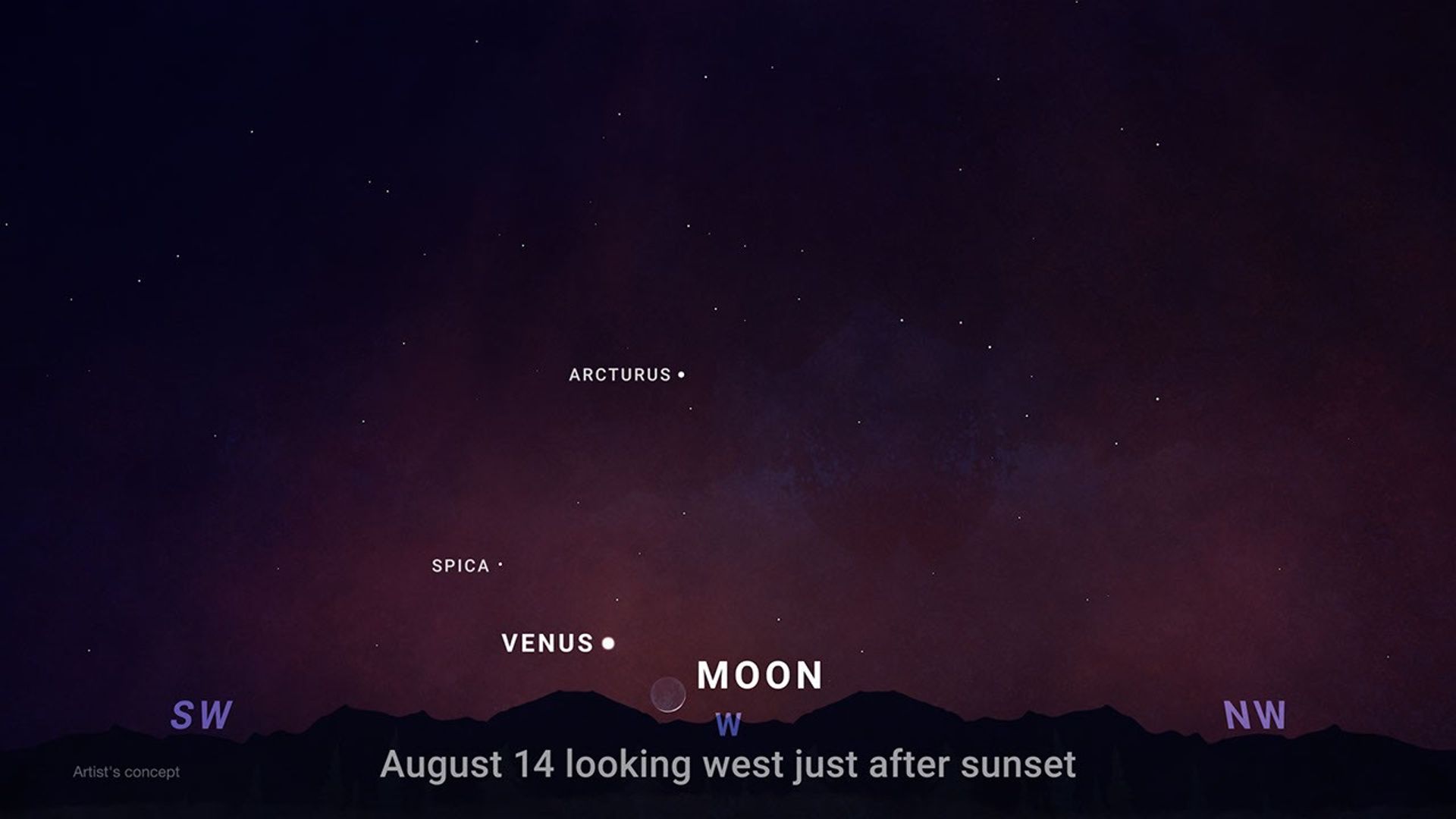
An illustration of the evening sky shortly after sunset, showing the positions of celestial objects. Text at the bottom center reads 'August 14 looking west just after sunset'. The bottom edge features a silhouetted, dark horizon of hills or mountains. Above the horizon, compass directions are indicated in purple: 'SW' (Southwest) on the left, 'W' (West) in the center, and 'NW' (Northwest) on the right. In the center, sitting very low on the horizon, is a faint crescent moon, labeled 'MOON'. Just to the left and slightly above the moon is a bright, white dot labeled 'VENUS'. Higher up and to the left of Venus is a smaller white dot labeled 'SPICA'. Above and to the right of Spica, towards the center of the image, is another labeled star, 'ARCTURUS'. The sky transitions from a deep reddish-purple near the horizon to dark blue at the top, sprinkled with numerous faint stars. In the bottom left corner, small text reads 'Artist's concept.'
Esta ilustração mostra onde observar Vênus após o pôr do sol em agosto. — Crédito: NASA/JPL-Caltech

Na noite de 27 de agosto, continuando por algum tempo em 28 de agosto em algumas zonas horárias, a Lua Cheia passa pela sombra da Terra, resultando em um eclipse lunar parcial. Ele será visível a partir de grande parte da América do Norte e da América do Sul, além de partes da Europa e da África.
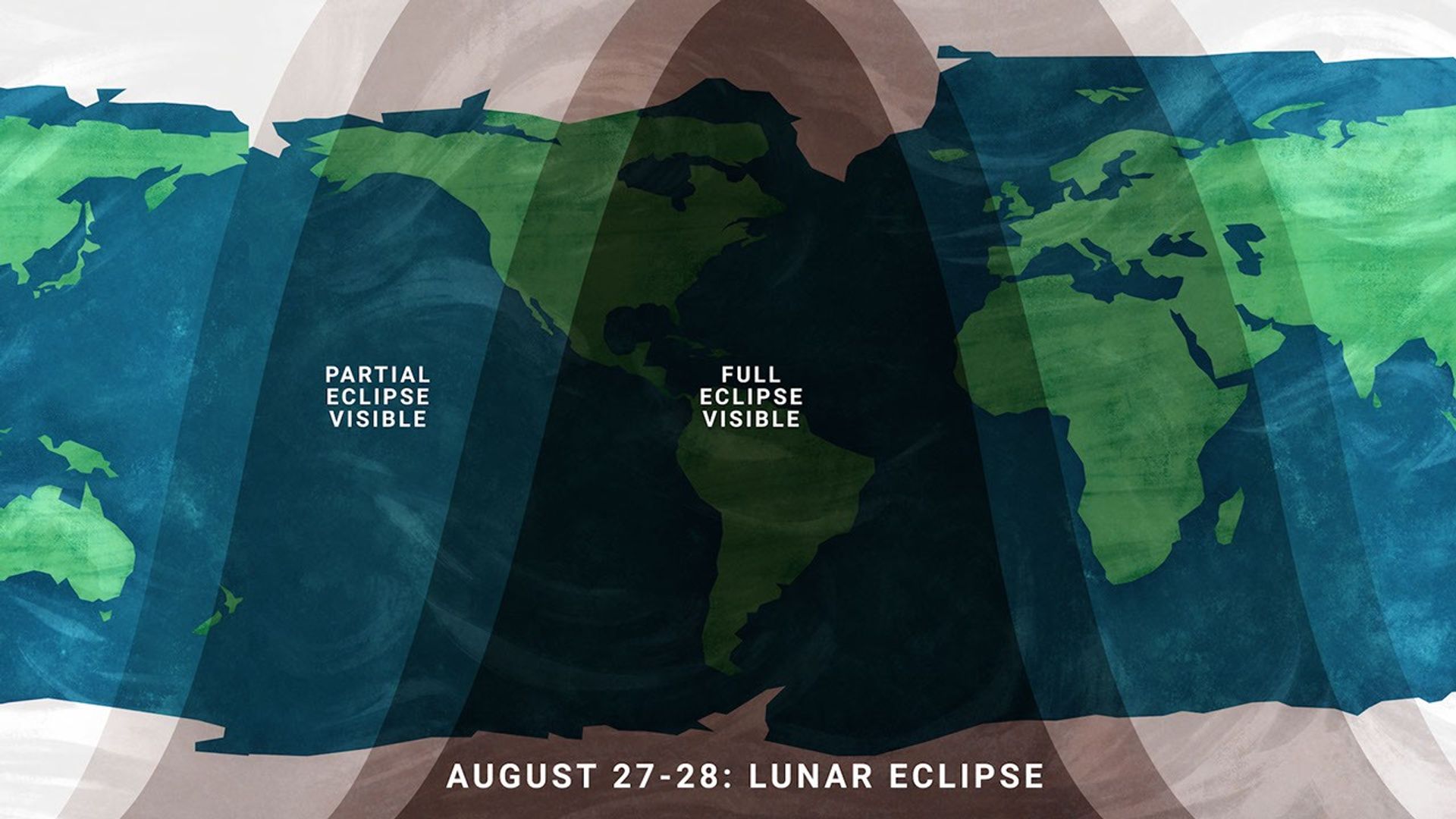
A stylized flat map of the Earth indicating the viewing areas for a lunar eclipse, with text at the bottom reading 'AUGUST 27-28: LUNAR ECLIPSE'. Large, semi-transparent dark bands arch across the map to represent visibility zones. The darkest central band, labeled 'FULL ECLIPSE VISIBLE', covers all of North America and South America, as well as the eastern Pacific Ocean and western Atlantic Ocean. Flanking this central region on the left and right are lighter shaded bands labeled 'PARTIAL ECLIPSE VISIBLE'. The western partial eclipse band covers the western Pacific Ocean and New Zealand, while the eastern partial eclipse band covers Europe and Africa. The unshaded outer regions of the map, including most of Asia and Australia, are areas where the eclipse will not be visible.
Áreas de visualização para o eclipse lunar de agosto de 2026. — Crédito: NASA/JPL-Caltech

No máximo do eclipse, cerca de 93% do diâmetro da Lua estará dentro da sombra central escura da Terra, chamada umbra. A Lua não ficará completamente encoberta, mas pode parecer dramaticamente escurecida, com uma tonalidade avermelhada, de cobre, ao longo da borda encoberta.

Diferentemente de um eclipse solar, um eclipse lunar é seguro de observar apenas com os olhos. Binóculos ou um pequeno telescópio podem oferecer uma visão mais próxima da sombra curva da Terra se movendo sobre a Lua.

Aqui estão as fases da Lua para agosto.
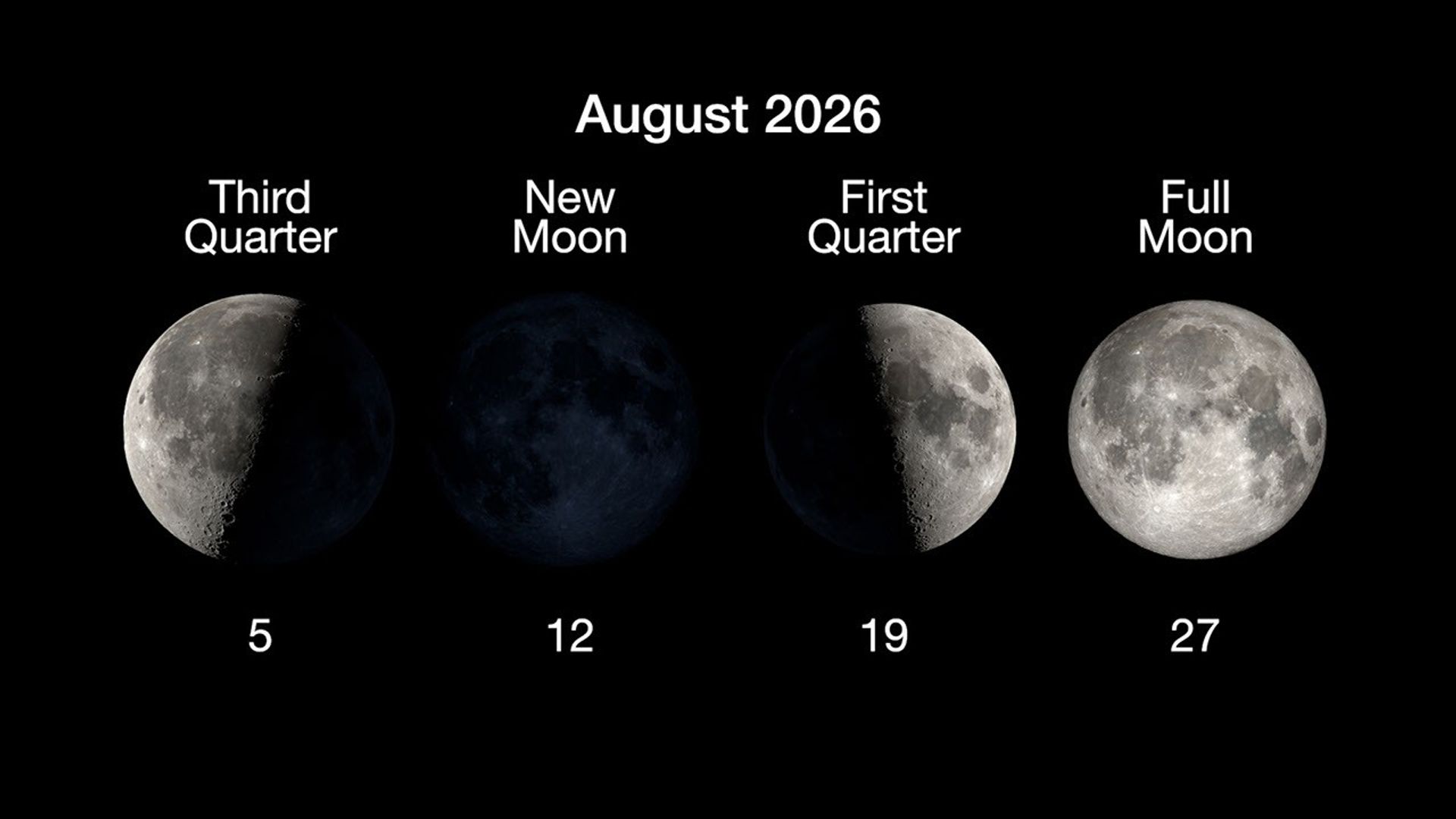
An infographic on a black background titled 'August 2026' showing four primary phases of the Moon arranged in a horizontal row. Each phase features an image of the Moon with text above indicating the phase name and a number below indicating the date in August. From left to right:  'Third Quarter' on the 5th, showing the left half of the Moon illuminated. 'New Moon' on the 12th, showing the Moon's face completely in shadow. 'First Quarter' on the 19th, showing the right half of the Moon illuminated. 'Full Moon' on the 27th, showing the entire face of the Moon illuminated.

NASA/JPL-Caltech

Você pode se manter atualizado sobre todas as missões da NASA explorando o sistema solar e além em science.nasa.gov . Eu sou Raquel Villanueva, do NASA’s Jet Propulsion Laboratory, e este é o What’s Up deste mês.

Encontre eventos e clubes de observação do céu com a NASA’s Night Sky Network

Mais recursos de observação do céu da NASA