Astronomia Brasil
notíciasNASA

Webb registra jatos estelares

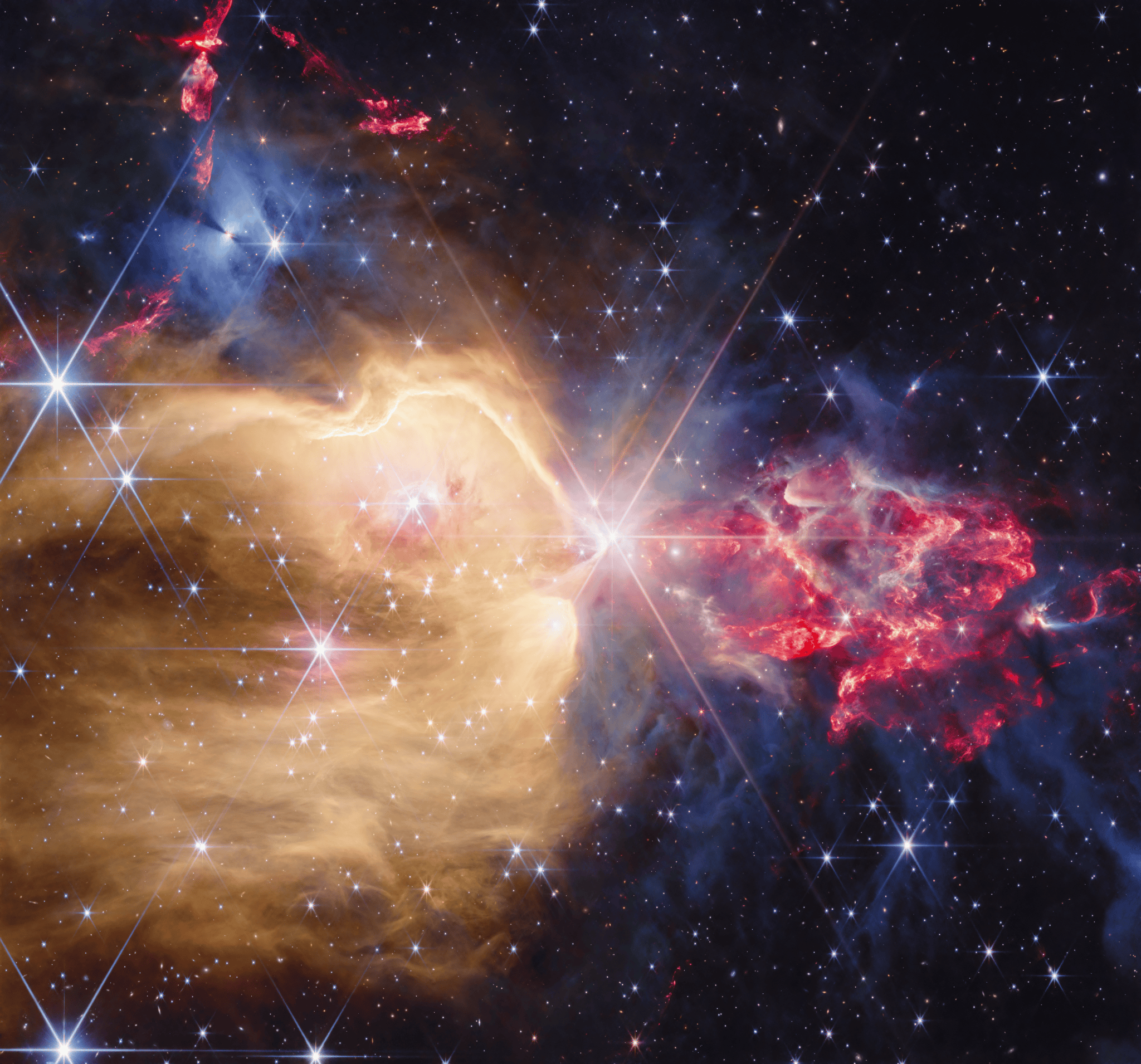
A young star cluster filled with many stars that display Webb’s unique eight-pronged diffraction pattern. At its center is a yellow star which sports the largest diffraction pattern. To the left of the star, there is a region filled with yellow dust and gas that extends from the star to the left border of the image. This yellow region extends from the bottom, covering about two-thirds of the image. The yellow region has several blue stars of different sizes embedded within. The top third, which lies outside of the yellow region, holds a few bright protostars, within dense gray gas. Those stars illuminate the gas, making it appear blue. A few red outflows from other protostars are visible above this grayish-blue region. To the right of the central star, there is a clumpy, flame-like plume of red dust and gas with protostars that emit a soft white light within. The plume is surrounded by more dense gray gas and dust. There are several background galaxies strewn throughout the image.
O Telescópio Espacial James Webb da NASA revelou muitas protoestrelas e estrelas nos gases brilhantes de NGC 7129. O gás hidrogênio atômico quente aparece aqui na região dourada, enquanto o gás hidrogênio molecular mais frio, chocado pelas protoestrelas em seu interior, é representado em vermelho. NASA, ESA, CSA, STScI; processamento da imagem: Alyssa Pagan (STScI)

Uma imagem do Telescópio Espacial James Webb da NASA, divulgada em 6 de outubro de 2026, revela um caldeirão de criação cósmica. Webb revelou inúmeras estrelas antes ocultas por nuvens de poeira em um berçário estelar conhecido como NGC 7129, situado a cerca de 3.300 anos-luz da Terra.

Saiba mais sobre essa região — e faça um passeio interativo por ela.

Crédito da imagem:  NASA, ESA, CSA, STScI; processamento da imagem: Alyssa Pagan (STScI)